Why Deadlocks, Hook Locks, and Shielding Plates Matter More Than Ever
Van theft is no longer a matter of opportunity—it’s often planned, fast, and highly targeted. Tools stored inside vans, especially trade vehicles, are valuable on their own, and in many cases the van itself becomes secondary to what’s inside it.
Factory security alone is rarely designed to deal with modern theft techniques. That’s why many owners are now turning to physical security upgrades like deadlocks, hook locks, and shielding plates to strengthen their protection.
These systems don’t replace factory security—they reinforce it.
Why vans are such a common target
Vans are attractive to thieves for a few key reasons:
- High-value tools and equipment stored inside
- Predictable parking locations (home driveways, worksites, streets)
- Standard factory locks that can be vulnerable to forced entry
- Rapid theft methods designed to take seconds rather than minutes
Unlike passenger cars, a van break-in often leads directly to business disruption, lost earnings, and expensive tool replacement.
This is where physical reinforcement becomes essential.
Deadlocks: adding a second line of defence
Deadlocks are one of the most effective upgrades for van security. Unlike standard locks, which can be controlled by the central locking system, a deadlock is a separate locking mechanism that must be manually engaged or electronically activated depending on the system.
Once locked, it physically prevents the door from being opened—even if the factory lock is compromised.
Why deadlocks are effective:
- Independent locking system separate from OEM locks
- Resistant to standard forced entry methods
- Adds an additional step for anyone trying to gain access
- Visible deterrent for opportunistic thieves
Deadlocks are particularly useful for side and rear doors, which are often targeted on work vans.
Hook locks: stronger resistance against forced entry
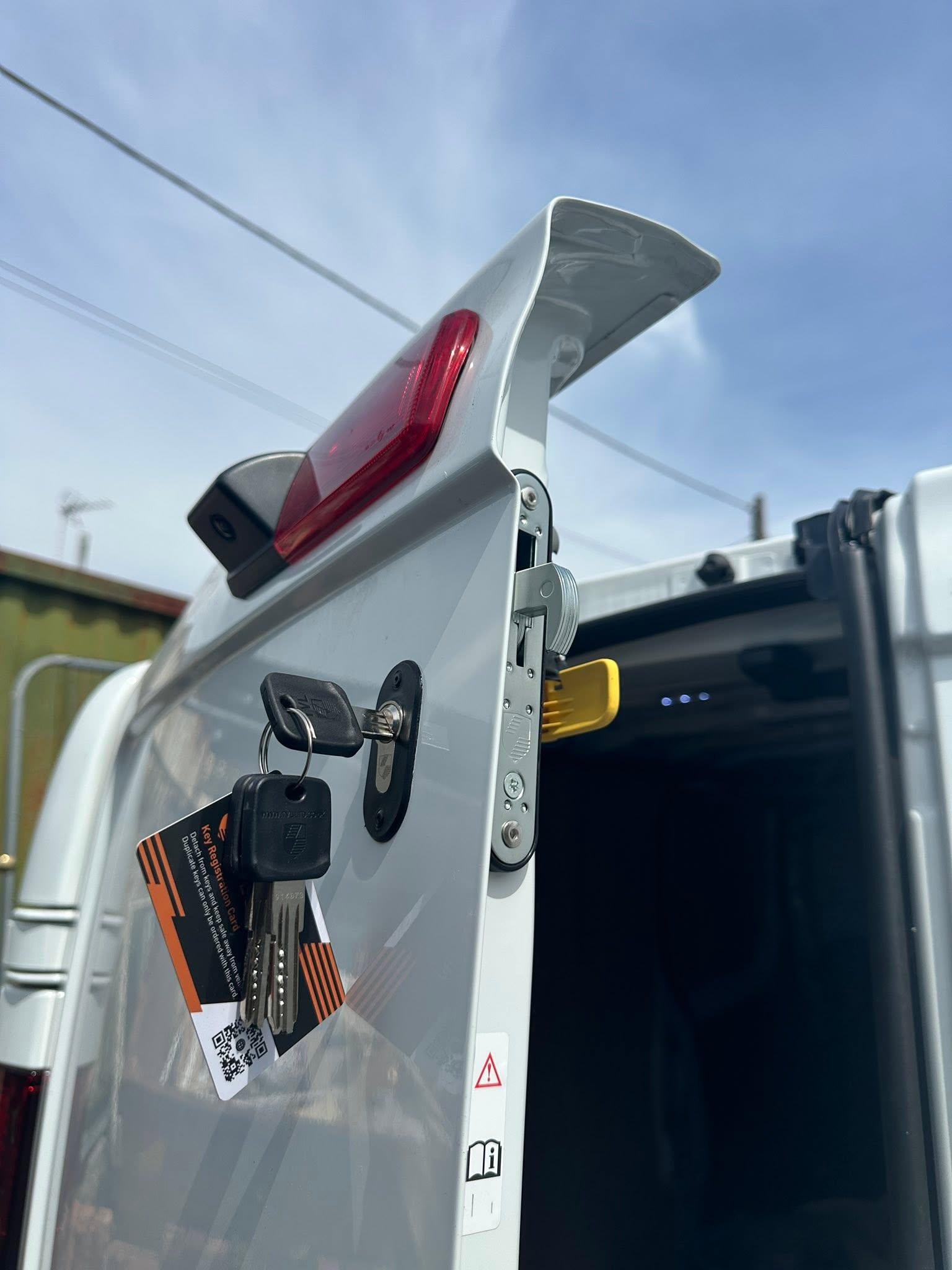
Hook locks are similar in purpose to deadlocks but use a different locking mechanism. Instead of a straight bolt, they use a hook-shaped bolt that latches onto a striker plate inside the van body.
This design makes it significantly harder to force a door open, especially under pressure.
Key benefits of hook locks:
- Strong mechanical engagement that resists pulling and prying
- Ideal for high-risk areas like rear and side doors
- Works independently of central locking systems
- Provides additional resistance during physical attacks
Hook locks are often chosen for vans carrying expensive tools or equipment, as they provide a high level of physical resistance against forced entry attempts.
Shielding plates: protecting the weak points
While deadlocks and hook locks protect the doors, shielding plates focus on something equally important—the internal mechanisms.
Modern thieves often target vulnerable entry points such as:
- Lock cylinders
- Cable linkages
- Internal door mechanisms behind panels
Shielding plates are reinforced metal covers installed inside the door to protect these components from drilling, pulling, or manipulation.
Why shielding plates are important:
- Prevent access to internal lock mechanisms
- Protect against drilling and tampering
- Reinforce areas that are often hidden from view
- Work alongside deadlocks and hook locks for full protection
Without shielding, even strong external locks can still be vulnerable if the internal mechanism is accessed.
REPLocks for Ford vehicles: a tailored security upgrade
Ford vans—particularly models like the Transit range—are among the most commonly used commercial vehicles in the UK, and unfortunately, they are also frequent targets for theft. Because of this, vehicle-specific solutions such as REPLocks have become a highly effective upgrade.
REPLocks are designed specifically for Ford vans to enhance the factory locking system with a more secure, reinforced mechanism.
What makes REPLocks different:
- Designed specifically for Ford van door systems
- Upgrades the factory lock with a stronger mechanical replacement
- Reduces vulnerability to common forced entry techniques
- Integrates neatly without affecting normal vehicle use
- Provides a higher level of resistance compared to standard OEM locks
For Ford Transit owners, REPLocks are often chosen as a direct replacement upgrade that strengthens the weakest points in the original locking design.
Layered security is the key
The most effective van security setups don’t rely on a single product. Instead, they use a layered approach:
- Factory immobiliser (baseline security)
- Deadlocks or hook locks (physical door reinforcement)
- Shielding plates (internal protection)
- Additional measures like alarms or tracking systems
Each layer increases the time, effort, and risk for a thief. In most cases, criminals will move on rather than spend time trying to overcome multiple barriers.
Deterrence is just as important as defence
One of the most overlooked aspects of van security is visibility. Thieves often look for the easiest target, not the hardest challenge. Visible security upgrades like locks and reinforced doors can act as a strong deterrent before any attempt is made.
A well-protected van signals one thing clearly: this vehicle will take time to break into—and time is something most thieves don’t want to spend.
Protecting your livelihood
For tradespeople and businesses, a van isn’t just transport—it’s a mobile workspace. Theft doesn’t just mean replacing tools; it can mean missed jobs, lost income, and damaged reputation.
Upgrading to deadlocks, hook locks, and shielding plates is a practical step toward protecting both your equipment and your ability to work without interruption.
Final thoughts
Van crime has evolved, and so should vehicle security. Factory systems alone are no longer enough in many situations. By reinforcing your van with mechanical upgrades like deadlocks, hook locks, and shielding plates, you significantly reduce the risk of forced entry and theft.
It’s not about making your van “theft-proof”—it’s about making it the least attractive target in the area